


Products Description
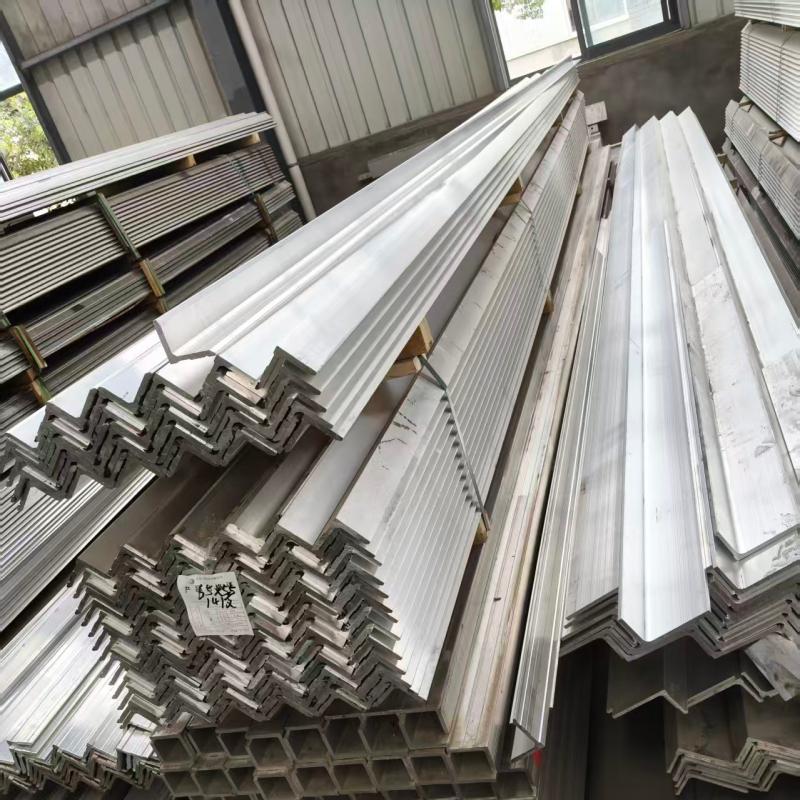
- Most formwork leaks start at an edge, not in the middle of a panel. Panels take the pour pressure; a bare 90° joint does not. The angle is the strip that closes it.
- Rolled from the same Zn-Al-Mg coil as the panels - yield above 700 MPa, 1500+ h salt spray, and sawn ends keep their protection on site. Legs equal or unequal, cut to your drawing, in 1.5 mm or 2.0 mm matched to the face plate and edge plate.
- Four places it works: panel borders and open edges; internal corners and 90° returns, backing the corner panel; infill strips at openings, columns and shafts; and back-face stiffening on wide panels.
- Need it lighter? The aluminium corner extrusion in 6061-T6 does the same job where weight matters more than yield. This one is steel - same coil, same coating, the Q700 generation of a profile range that used to stop at Q235/Q345.
- Holes are punched to your pin pitch before shipment. Match the thickness too: a 2 mm edge plate takes 2 mm angle, flush; 1.5 mm on a 2 mm edge leaves a step the concrete reads.
01
Same Coil as the Panel
One ZAM coil, yield above 700 MPa, 1500+ h salt spray, so the angle ages at the rate of the panels bolted to it - the same 300-cycle target.
02
90° That Stays 90°
The roll set over-bends against springback, so the leg lies flat on the panel rib instead of standing open at the corner.
03
Cut Ends Stay Protected
ZAM heals a sawn face. An angle cut at a door opening does not rust first and bleed a streak down the finished wall.
04
Punched Before Shipment
Legs punched and drilled to your pin pitch in the shop, so nothing is drilled on site and no swarf ends up inside the formwork.
Why Choose Us
Specialized in formwork and shoring systems; panels, profiles and accessories from one works.
ISO 9001, CE.
Inquiry replied within 24 hours, quotation within 1 working day.
Panels, angles, pins and wedges, walers and tie systems supplied as a complete Q700 package.
Container-optimized packing, FOB Qingdao worldwide shipping.
Applications
Four places it earns its keep
The same angle, used four different ways. .
Internal Corners and 90° Returns
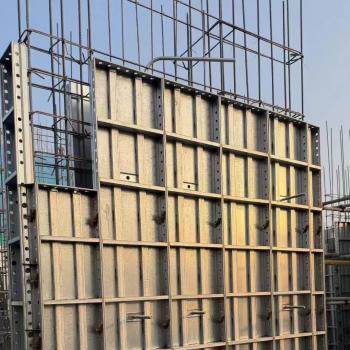
Two Q700 panels meet at an internal corner and the seam is where grout escapes first. The angle is bolted on the back face and closes that line while the pour is going in - the corner panel shapes the face, the angle backs the joint. At external corners, the external corner connector ↗ makes the span; the angle only backs it up on both sides.
Openings, Box-Outs and Shaft Walls
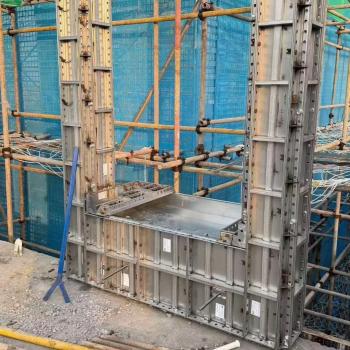
Door and window openings, elevator shafts and service ducts never land on a standard panel module. Framing them with angle as the infill strip saves cutting full panels on site - no scrap, no hot work, and the closed edge stays square against concrete pressure.
Panel Borders and Open Edges
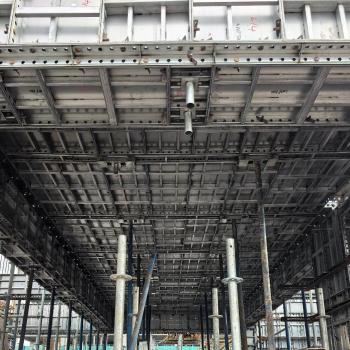
The open edge of a flat or beam panel is where the plate lifts and leaks under pour pressure. An angle pressed over the border keeps the edge plate flat, so grout has nowhere to run and the finished edge comes off the form clean.
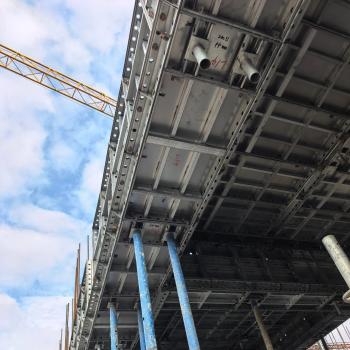
Back-Face Stiffening on Wide Panels
Wide flat plates bulge in the middle when the span outruns the rib spacing. Angles set vertically on the back face work as stiffeners, holding the plate in line without adding a second layer of walers.
Specifications
Product Specifications
(vs. Alternatives)
| products |
High-Strength Alloy Formwork Steel Angle
|
Aluminium Corner Extrusion
|
Site-Cut Q235/Q345 Plate
|
| Material | Q700 alloy steel, yield ≥700 MPa | 6061-T6 aluminium | Q235 / Q345 steel |
| Coating | ZAM, 1500+ h salt spray, cut-edge self-healing | Anodized 15 μm+ | Galvanized or painted, cut edges unprotected |
| Corner geometry | Cold-formed 90°, over-bent against springback | Extruded 90° | No formed corner - cut and welded on site |
| Fit with Q700 panels | Same coil, same coating, flush at 2 mm edge plates | Different metal and coating | Older profile generation (Q235/Q345) |
| Reuse cycles | 300+ design target | Not specified | Not specified |
Related products
From Raw Material to Container
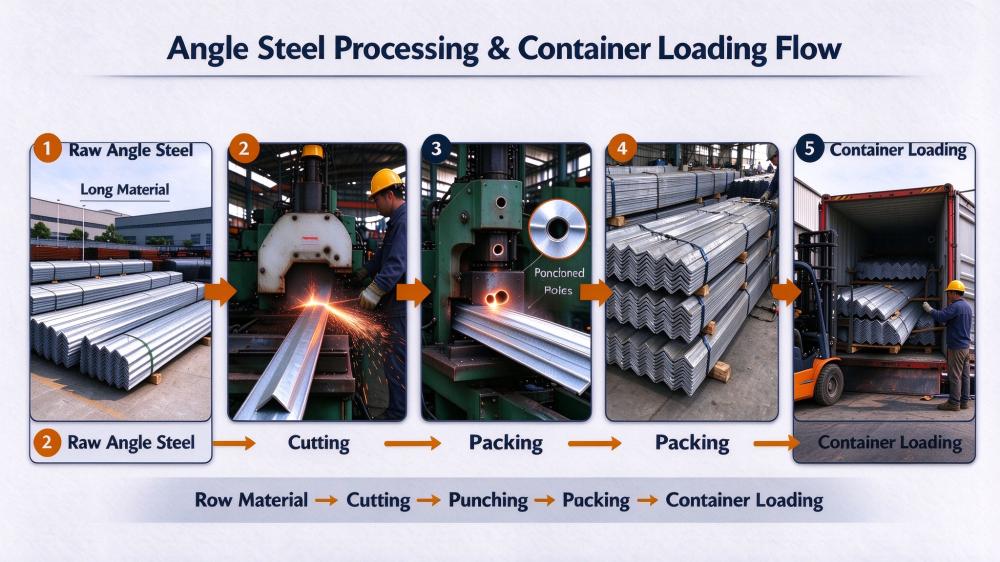
Products Description
Frequently Asked Questions
How is it different from the steel formwork corner panel?
+
-
The corner panel is a formed plate that shapes the concrete face at internal and external corners. The angle is a bar that sits behind the panels and closes the joint line. One shapes the face, the other backs the seam - they work together and do not replace each other.
Steel angle or aluminium corner extrusion - which one?
+
-
Both do the same job. The 6061-T6 aluminium extrusion is lighter and the right pick where weight matters more than yield. The Q700 steel angle carries the same coil and coating as the panels, bolts into a Q700 wall without mixed metals, and holds a tighter corner in thin gauge.
Can the angle replace a waler?
+
-
No. The load path runs through the square steel tube walers and the tie system. The angle is a construction trim on the back face - it closes edges, backs corners and stiffens plates. It is not a load-bearing member and is not sold as one.
What about MOQ, samples and delivery?
+
-
MOQ:5 MT per size ; Delivery Time:In-stock regular sizes( 7–10 working days upon deposit). Samples cut to your drawing are available; inquiries are answered within 24 hours and quotations within one working day.
-

One-stop Formwork Factory in China
CONTACT US with your joint detail, panel thickness and pin pitch, and we will confirm the leg size, the thickness and the punching for your layout.


